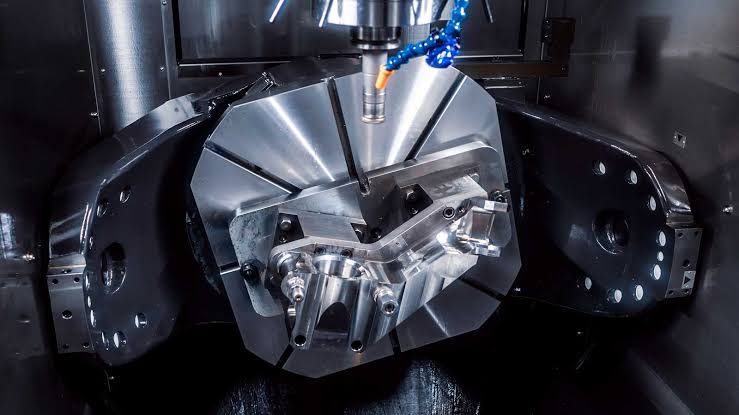

Modern manufacturing industries require exceptional accuracy, speed, and flexibility to produce complex components with strict quality standards. Traditional machining methods often face limitations when working with intricate designs, difficult angles, and complex geometries. This is where 5 axis cnc machining has become a revolutionary technology, allowing manufacturers to achieve higher precision and efficiency through advanced multi-axis movement. By controlling five different axes simultaneously, this machining process provides improved accuracy, reduced production time, and enhanced capabilities for industries such as aerospace, automotive, medical, and industrial equipment manufacturing.
Understanding 5 Axis CNC Machining Technology
5 axis cnc machining is an advanced computer numerical control process that allows a cutting tool or workpiece to move along five different axes during a single machining operation. Unlike conventional three-axis machining, which moves along the X, Y, and Z linear directions, five-axis technology adds two rotational axes. These additional movements allow the cutting tool to approach the workpiece from multiple angles, making it possible to manufacture highly complex parts with exceptional precision.
The primary advantage of this technology is its ability to complete complicated machining tasks in fewer setups. Traditional methods may require repositioning the workpiece multiple times to reach different surfaces, increasing the possibility of alignment errors. With 5 axis cnc machining, manufacturers can machine multiple sides of a component in one setup, ensuring consistent accuracy and reducing manufacturing challenges.
How Multi-Axis Movement Improves Manufacturing Precision
Precision is one of the most important factors in modern production environments. Industries that manufacture critical components require extremely tight tolerances to ensure safety, reliability, and performance. 5 axis cnc machining improves precision by maintaining continuous contact between the cutting tool and the workpiece while adjusting tool angles automatically.
The ability to rotate and position the cutting tool at optimized angles creates smoother machining operations. This reduces tool vibration, minimizes surface imperfections, and improves the overall finish of manufactured components. As a result, businesses can produce parts that meet strict engineering requirements without requiring additional finishing processes.
Another major benefit is improved dimensional accuracy. Since the component remains securely positioned throughout the machining process, there is less risk of errors caused by repeated setups. This makes 5 axis cnc machining an ideal solution for manufacturing complex parts where accuracy is essential.
Benefits of Using 5 Axis CNC Machining in Modern Industries
The adoption of advanced machining technology has transformed how manufacturers approach product development and production. 5 axis cnc machining offers several advantages that help companies improve productivity and maintain competitive performance.
One of the biggest benefits is faster production. Because multiple surfaces can be machined in a single operation, manufacturers spend less time adjusting fixtures and repositioning materials. This reduces overall production cycles and allows businesses to complete projects more efficiently.
Another important advantage is the ability to create complex geometries. Many modern products require components with curved surfaces, deep cavities, and unique shapes that are difficult to manufacture using traditional equipment. Five-axis technology provides the flexibility needed to produce these challenging designs with greater accuracy.
The technology also improves material efficiency. Since the cutting tool can access difficult areas more effectively, manufacturers can reduce unnecessary machining operations and minimize material waste. This makes the process more cost-effective while supporting sustainable manufacturing practices.
Applications of 5 Axis CNC Machining Across Industries
Many industries depend on advanced machining solutions to produce high-performance components. In the aerospace sector, manufacturers use 5 axis cnc machining to create lightweight and complex aircraft parts that require exceptional strength and accuracy. Components such as turbine blades, structural parts, and engine components often involve complicated shapes that benefit from multi-axis capabilities.
The automotive industry also relies on this technology for producing precision parts, prototypes, and performance components. Vehicle manufacturers use five-axis machining to develop complex engine parts, transmission components, and customized designs with improved efficiency.
In the medical field, 5 axis cnc machining plays an important role in producing surgical instruments, implants, and medical devices. These products often require extremely precise dimensions and smooth surface finishes to ensure safety and functionality.
Industrial equipment manufacturers also benefit from this technology by creating durable machine components, molds, and specialized tools. The flexibility of multi-axis machining allows companies to handle a wide range of manufacturing requirements.
The Role of CAD and CAM Software in 5 Axis Machining
Advanced software systems are essential for maximizing the capabilities of 5 axis cnc machining. Computer-aided design (CAD) software helps engineers create detailed digital models, while computer-aided manufacturing (CAM) software converts these designs into precise machining instructions.
Modern CAM systems can automatically calculate tool paths, optimize cutting angles, and prevent potential collisions during production. This automation improves accuracy and reduces programming errors. By combining powerful software with advanced CNC equipment, manufacturers can achieve higher levels of efficiency and consistency.
The integration of digital technologies also supports rapid prototyping and product innovation. Engineers can quickly modify designs, test new concepts, and produce accurate prototypes before beginning full-scale production.
Challenges and Considerations of 5 Axis CNC Machining
Although 5 axis cnc machining provides many advantages, successful implementation requires skilled operators, advanced programming knowledge, and proper equipment maintenance. The complexity of multi-axis movements means that manufacturers must carefully plan machining strategies to achieve the best results.
Initial investment costs can also be higher compared with traditional CNC machines. However, the long-term benefits, including reduced production time, improved quality, and lower operational costs, often make the investment worthwhile.
Choosing the right machine configuration, cutting tools, and software solutions is essential for achieving optimal performance. Manufacturers must evaluate their production needs and select technology that matches their specific requirements.
Future Developments in Multi-Axis Manufacturing Technology
The future of manufacturing continues to move toward automation, digital integration, and smarter production systems. Advances in artificial intelligence, robotics, and machine learning are expected to further improve the capabilities of 5 axis cnc machining.
Smart CNC systems can monitor machining conditions, detect potential issues, and automatically adjust operations to maintain quality. These innovations will help manufacturers increase productivity while reducing downtime and operational challenges.
As industries continue demanding more complex and precise components, multi-axis machining technology will remain a key part of advanced manufacturing. Companies that adopt these solutions can improve their production capabilities and deliver higher-quality products in competitive markets.
Conclusion
5 axis cnc machining has transformed precision manufacturing by providing unmatched flexibility, accuracy, and efficiency. Its ability to machine complex components from multiple angles in a single setup makes it an essential technology for modern industries. From aerospace and automotive applications to medical devices and industrial equipment, this advanced machining method helps manufacturers achieve superior results while reducing production time and improving overall quality.
As technology continues to evolve, 5 axis cnc machining will play an increasingly important role in shaping the future of manufacturing. Businesses that utilize advanced multi-axis solutions can achieve greater innovation, improved performance, and long-term success in a rapidly changing industrial environment.